
the Game
Special skills, and a locker room that remembers
Two things went live today. Every player can now carry up to three special skills or weaknesses that your scouts and the film have to find. And the locker room has a memory: groups, grudges, and trade demands that start in private. Screens and real numbers inside.
Two things went live in HoopSim today, and both are about the people on your roster rather than their ratings. The first is special skills: the small habits that separate two players with the same grades. The second is the locker room. Players now sit in groups, remember how they were treated, and, when something really isn't working, ask out.
Part one · Special skills
Thirty small edges
There are 30 special skills: 19 skills and 11 weaknesses. Each one is a small nudge in one situation, on top of a player's ratings and his role. A Clutch shooter is a little better in the last minutes of a close game. A Rim Deterrent makes opponents finish a bit worse at the rim while he's on the floor. A Foul Prone big picks up cheap fouls and gets into foul trouble early. None of them turns a bench player into a star. They make the same grades play a little differently, and they give you one more reason to choose one player over another.
 Card
Card How he plays
 Not read yet
A player carries at most three. Most players carry none or one. Two is uncommon, three is rare, and nobody holds both sides of a pair. Here is how it came out across the two leagues on launch day.
Earned on the floor, not handed out
Skills aren't random and they aren't a trait you buy. They are earned and lost from real play: a player's ratings, his role and what he actually does over a season. Every offseason the list is checked again. A shooter who stops hitting from the corner can lose Corner Specialist. A young player who learns to finish through contact can earn it. Nothing changes in the middle of a season.
You have to find them
This is the part I like most. You don't get to see the list. A skill shows up only when your scouts spot it or the film shows it.
- 1Your scoutsScouts with a read on a player can spot a good skill that shows on tape. They never report a weakness.
- 2The filmGood skills go public after about 10 games of film, late-game skills after about 15, and weaknesses only after about 20.
- 3Your own playersYou watch your own team every night, so your own players' film reads faster.
- 4The revealA Film room card on your Start page and a note in your inbox.
Until then a player shows an unknown stamp and a film bar that counts down to a full read. When something new turns up, your Film room card tells you, and a note lands in your inbox.
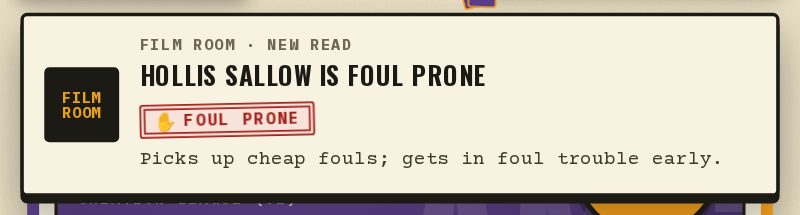
Film started counting today, the day skills went live. Nothing is retroactive, so the first film reveals will arrive over the next few weeks of games, a few at a time.
Where you'll see them
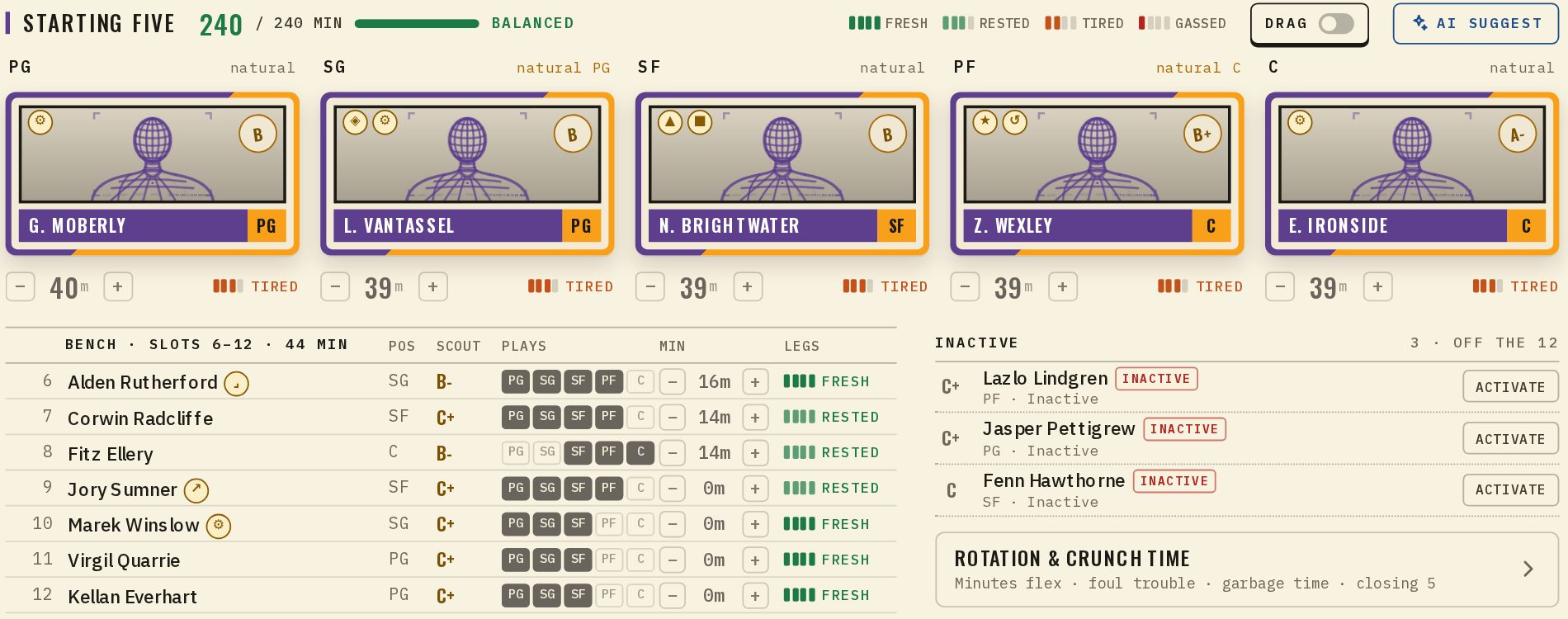
Once you know about a skill, it travels with the player: stamps on his card and in HOW HE PLAYS, on your roster, on the depth chart, in free agency and in the trade builder.
 Trade builder
 Free agents
 Draft
Draft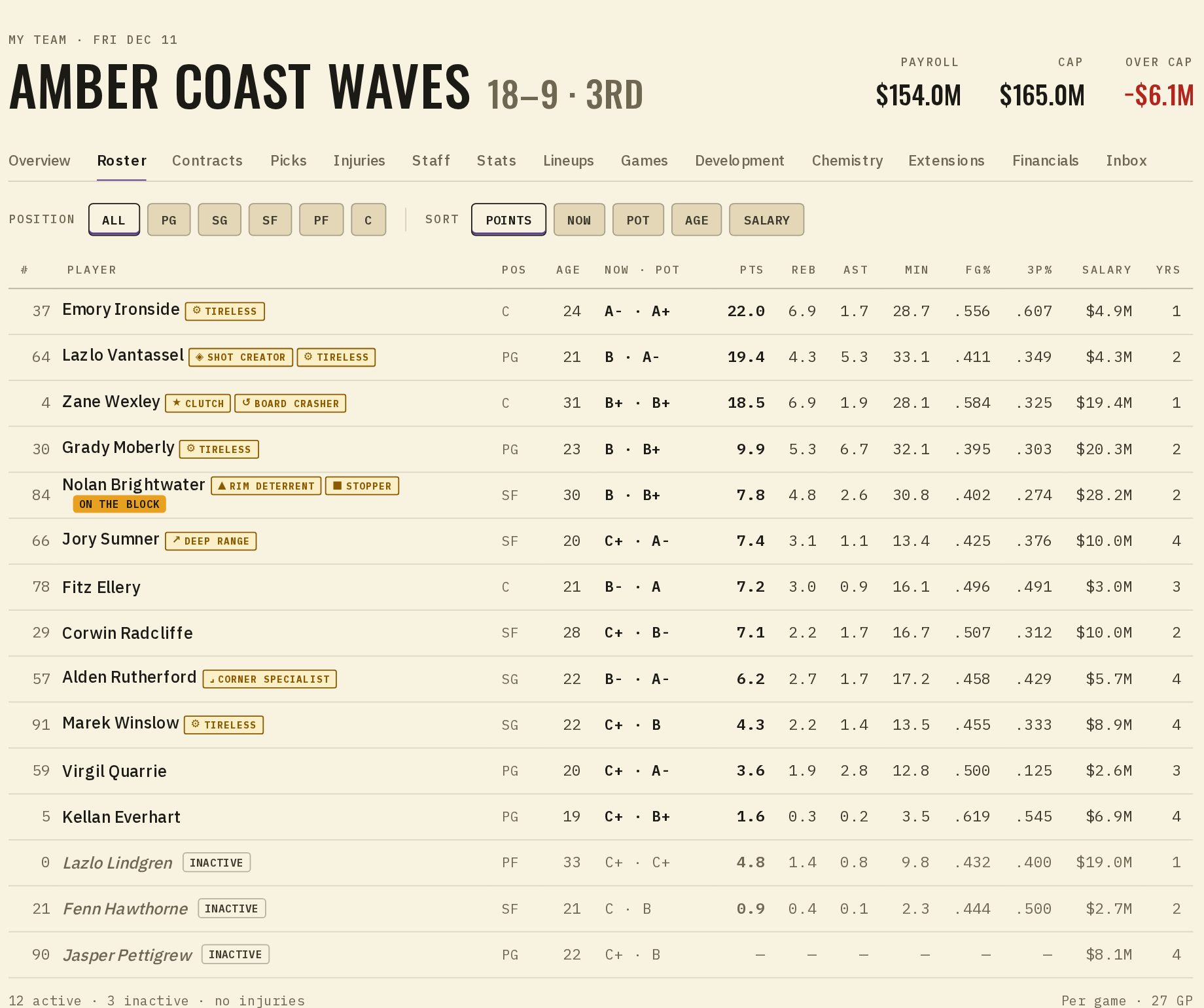
Draft prospects get stamps too. Before a prospect plays a game, your own scouts can project a skill for him, marked as a projection. The games will confirm it or they won't.
- 1Scouts projectYour own scouts can project a skill for a prospect before he plays a game. It's their read, and other clubs don't see it.
- 2Games confirmOnce he plays, the film takes over, the same way it does for everyone else.
Fair for everyone
The same fog applies to everyone. The AI front offices value only the skills they can see. A skill nobody has seen yet isn't in anyone's price. The media only mention a skill once the film has made it public. Commissioners get a Skill strength setting to make the effects stronger or softer for their league.
Before launch I ran thousands of staged games with skills on and off. League-wide scoring, shooting, turnovers, fouls and pace barely moved, and every league-wide number stayed within tight limits. That was the goal. Skills change who wins a particular moment. They don't change what a HoopSim game looks like.
Part two · The locker room
Groups
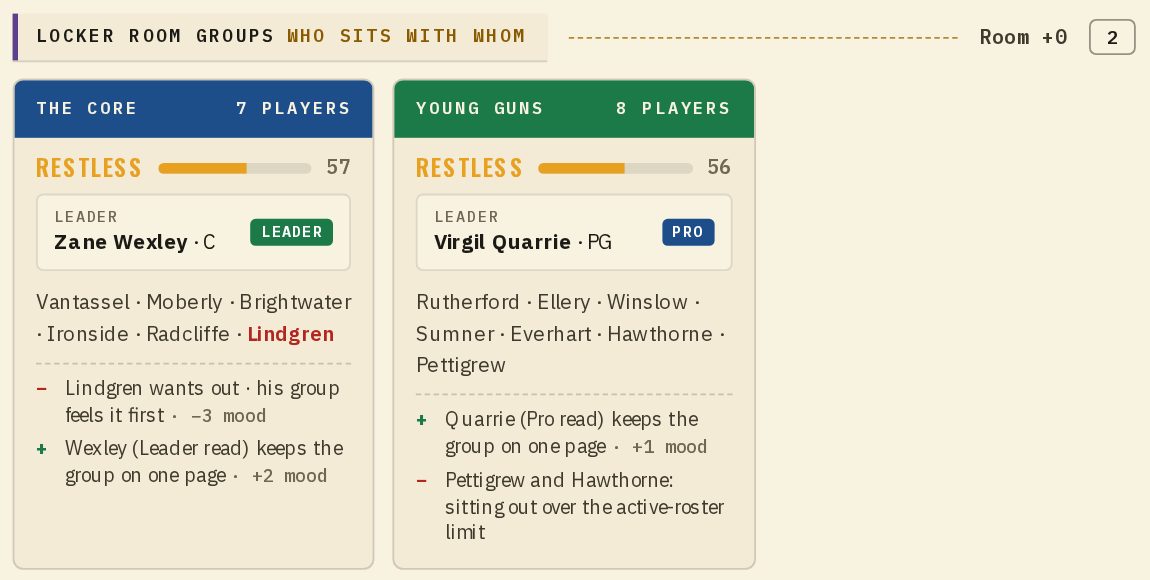
Every roster now sorts itself into groups: The Core, Young Guns and New Arrivals. Nobody assigns them. They form on their own from who has been around, who plays the big minutes and who just walked in the door. Each group has a leader, picked using your own scouting read of the players' makeup, and each group has a mood. That mood feeds your team chemistry. A room where one group is fractured while another is settled costs you. A room where every group is settled helps.
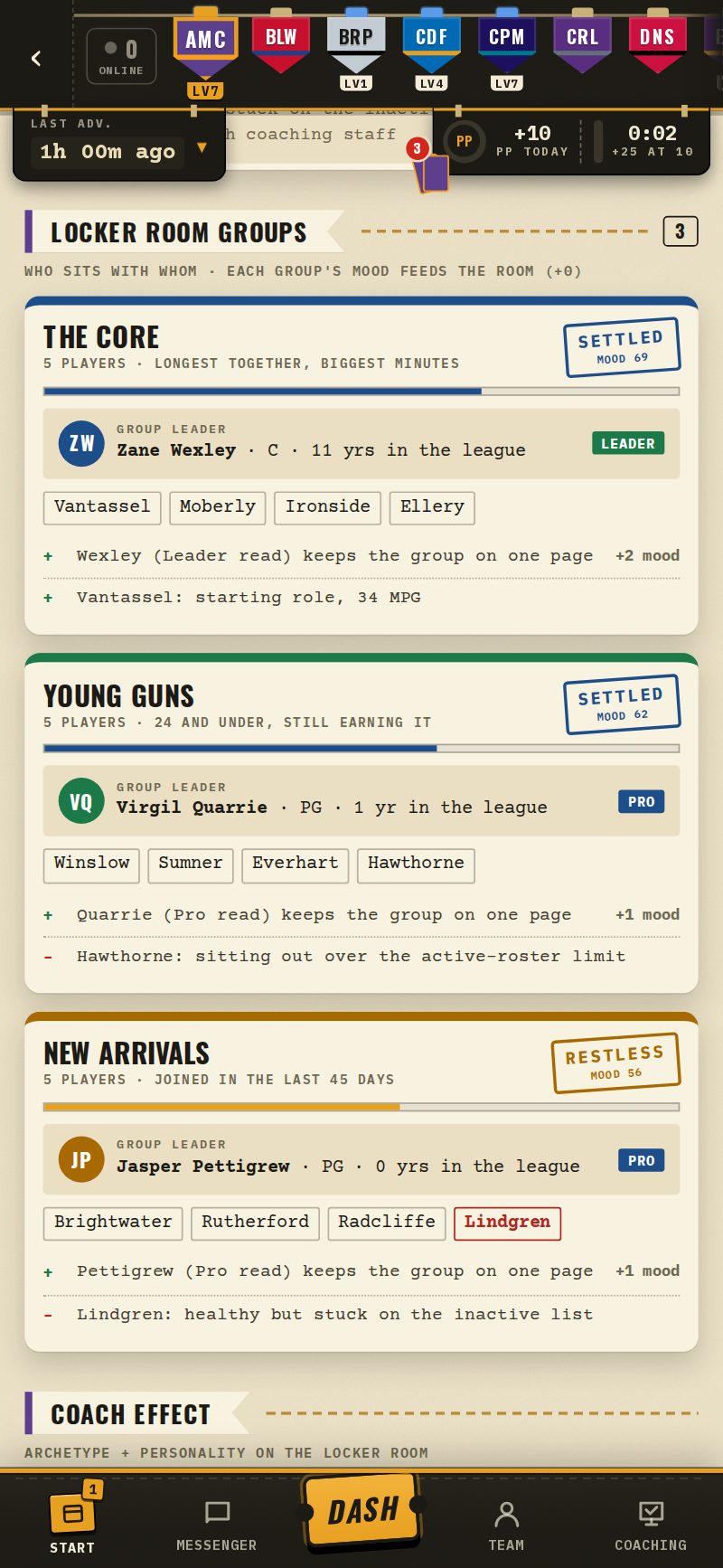
You see your own team's groups and nobody else's. They are under Team › Chemistry, on your phone and on a computer.
Trade demands, in three steps
Sometimes a player stays unhappy for weeks over something you could fix: his minutes, the losing, his contract, or a grudge. If he matters to the team, he will eventually ask out. He doesn't start on the Wire. He starts with you.
- 1PrivateHe DMs you first. Just you and him. Nothing leaves the thread.
- 2His agentAbout a week later, if nothing changes, his agent starts calling teams. Word gets out and the room feels it.
- 3PublicAbout a week after that, it's on the Wire and in League chat, and other clubs can make offers.
The first step is a private DM with a card and four choices: promise him minutes, tell him the truth, ask him to wait, or let his agent shop him. Nothing leaves that thread.
 Private
 His agent
If nothing changes, his agent starts calling teams about a week later, and word gets around. About a week after that it goes public on the Wire and in League chat, and other clubs can call.
 The Wire
 League chat
 Player card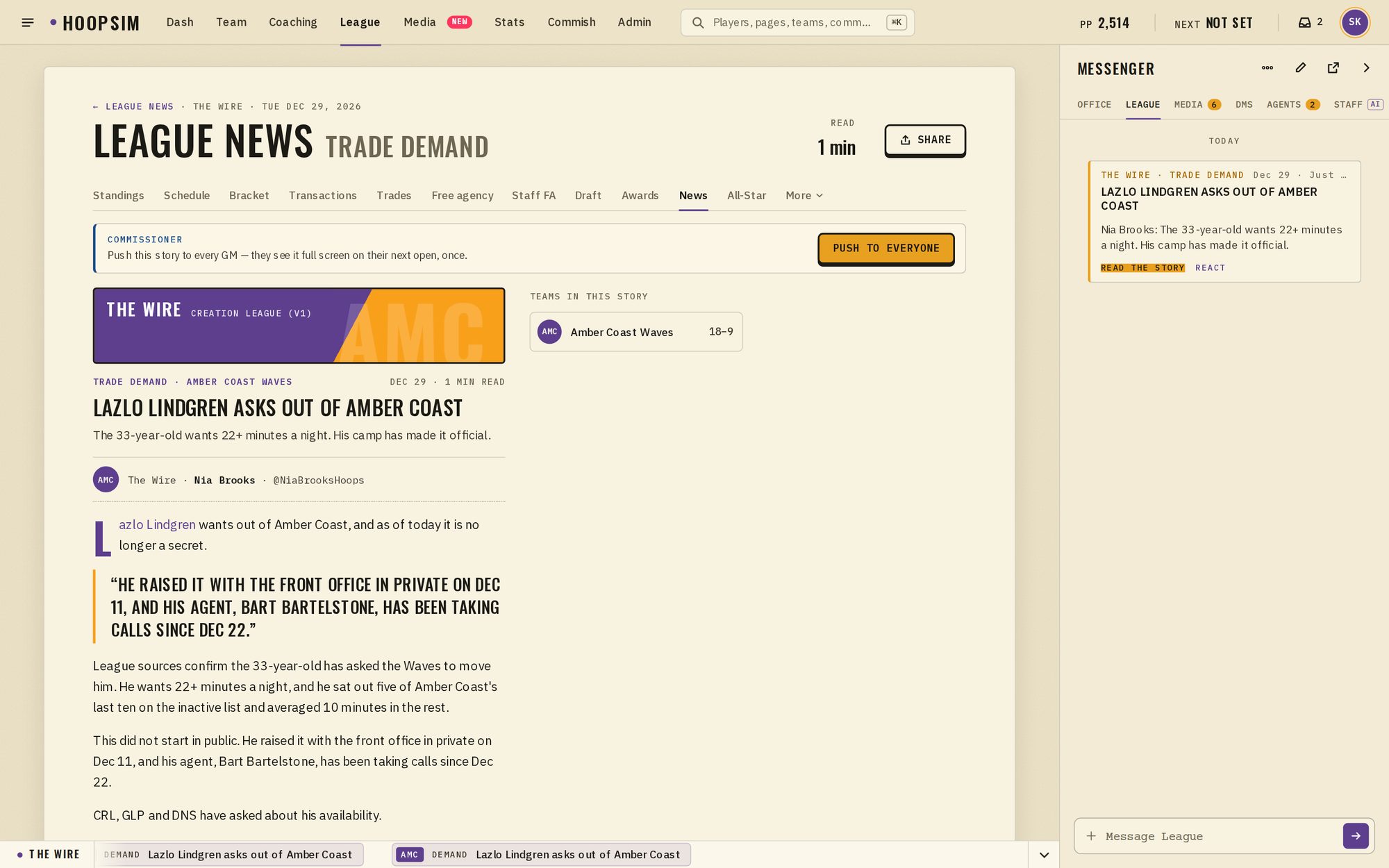
Every step can be stopped. Get him his minutes back, start winning if losing was the problem, sign him to a new deal, or trade him. A kept promise ends it. A broken promise moves it to the next step, and he remembers it.
And a demand never forces anything. He keeps playing every night. No player sits out or gets traded because of a demand. What it costs you is chemistry, and the longer it goes on, the more it costs.
There are limits to keep demands rare: one per team at a time, spaced out across the league, and a cooldown afterwards. This also replaces the older "unhappy" asks from agents, so you'll get fewer of those messages, and the ones you do get will mean something. The AI clubs live by the same rules. They can sell their own unhappy players, and they will make offers on a player whose demand has gone public.
One more thing: nobody's demand can start for the next couple of weeks of league time. A player has to stay unhappy for 14 league days in a row before he asks, and that clock started today.
Grudges
Players remember. Being cut, traded, sent to the bench, lowballed in contract talks, or promised something that never happened all stay with them. A grudge shows up in what he asks from your club for a contract, in whether he'll re-sign with you at all, in his DMs, and in his interviews. It fades over time, and it eases when the club changes GMs.
 Former player
 Re-sign
And yes, there are revenge games. When a player faces a club he holds a grudge against, he gets a small boost that night.
For commissioners
Commissioners have a Player Unrest setting with three choices: Off, Rare and Normal. Normal is the default. Off stops new demands, and grudges and groups keep running. The Office desk also has a league-wide unrest sheet that shows every unhappy player, his stage and his top reason.
 Setting
 Office desk
“The ratings tell you how good he is. The skills tell you how he plays, and the locker room tells you how he feels.”
Look at your Chemistry tab tonight, and keep an eye on your Film room. Tell me what you find.
— Dr. Possession