
the Game
How Player Development Works
How players grow, peak and fade in HoopSim, what training camp really does, why potential isn't fixed, and the new breakout years: the kid who plays above his card can now become something.
You ask me some version of the same question every week. Is my nineteen-year-old going to be any good? Does training camp matter? Can a guy at the end of the bench turn into somebody? This edition answers all three, and it comes with news: player development just got an update, and the biggest part of it is the one you've been asking for. Players can break out now.
The shape of a career
Every player in HoopSim is on a curve, and age decides where. Young players grow every year. The best years of growth are the early ones, and they slow down as a player gets close to what he can become. The middle of the twenties is the prime: most players hold what they have. After that, the slide starts. It's gentle at first, and it gets real in the early thirties.
None of that is new, and we measured it to make sure it still feels right. We ran hundreds of simulated off-seasons on a copy of a real league and followed every player for five years. The curve held up: young players climb, primes hold, and veterans fade at a pace that looks like the real game. We left it alone.
Where growth comes from
A player gets better in three places.
- 1During the seasonYoung players with real minutes pick up small gains as the games go by.
- 2At season's endThe big step: age, minutes, the coaching staff and how he was used decide where he grows.
- 3Training campYour plan. The 100 points you spread across six areas turn into attribute gains before the season.
Training camp, now with teeth
Camp is the one part of development you control directly. Every player gets a 100-point budget, and you spread it across six areas: inside game, shooting, handling, post defense, perimeter defense and conditioning. When the commissioner moves the league from training camp to preseason, your plans turn into attribute gains, and every player gets a Camp Report.
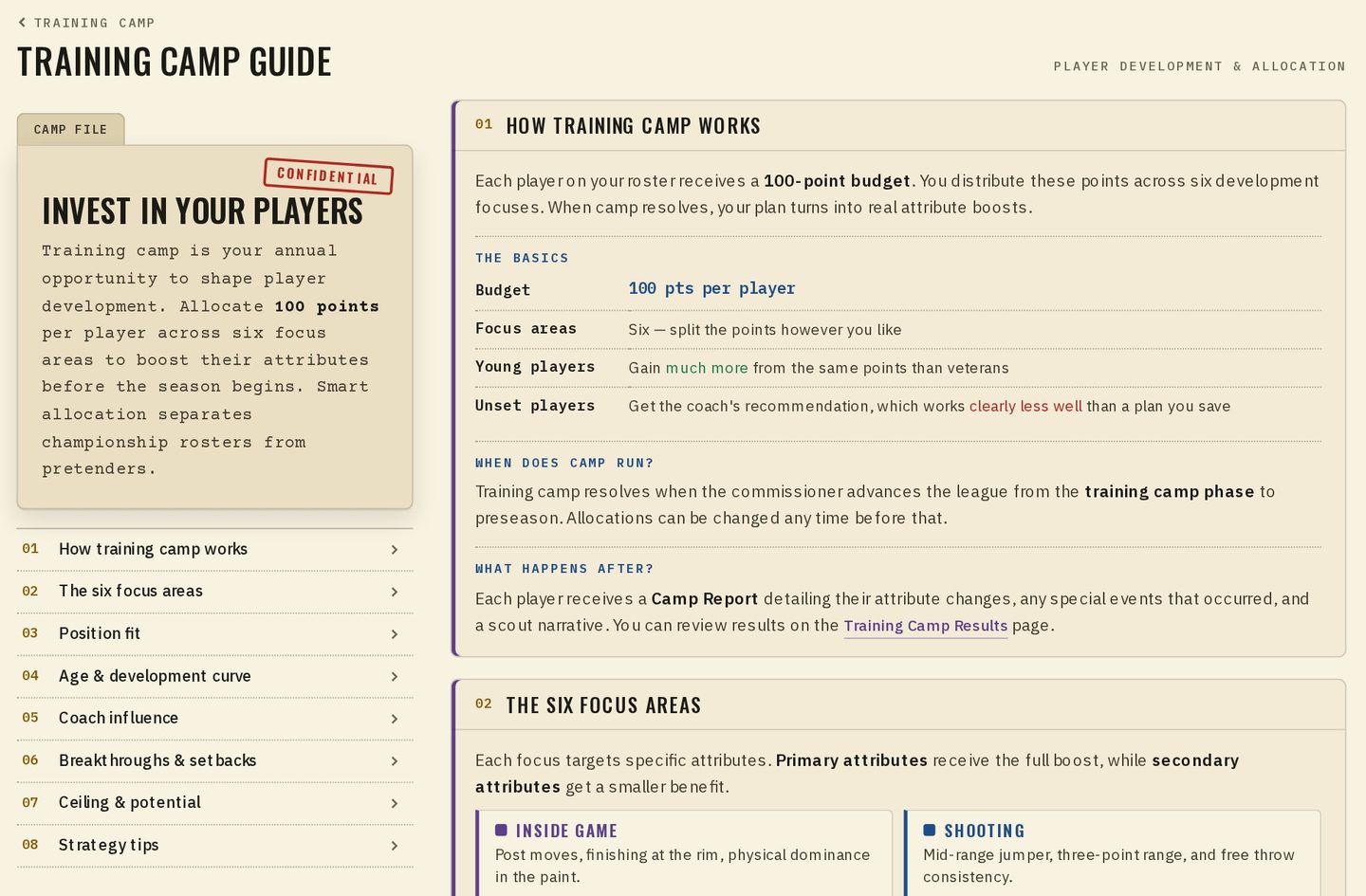
Here's the honest part. When we measured camp, it was too quiet. A season's worth of planning moved most players so little that you couldn't see your choices in the results. That's fixed. Camp gains are now about twice as big, so the plan you make shows up on the floor. The difference between a saved plan and a blank one is now real, too.
The rules of thumb haven't changed, they just pay off more now. Camp points go furthest on young players who are still far from their ceiling. Lean into one or two areas, but don't dump everything into one, because that's how players overtrain. Your coaching staff matters too: a good development coach turns the same points into more.
Potential isn't fixed
Every player has a ceiling, his potential. Your scouts read it for you, and their read gets sharper the longer they watch him. The true number can move.
For young players it can rise. The things that push it up are the things you'd expect: youth, real minutes, a season of real growth, and a strong head coach. It can also fall. A player who stalls for a couple of seasons, or one who gets older, sees his ceiling come down. From the late twenties on it only goes one way.
One small fix here: a player's potential now never sits below what he already is. If a player outgrows his ceiling, the ceiling moves with him.
New: breakout years
This is the part I'm most excited about. Until now, potential was close to a hard ceiling. A role player stayed a role player, and the guy at the end of your bench stayed there. In five years of simulated seasons, we couldn't find a single player who went from the bench to the starting lineup on his own.
That changes today. If a young player gets real minutes and plays clearly better than his rating says, he can have a Breakout Year. His ceiling jumps, his game takes a visible step right away, and if he's still playing the next season, he keeps climbing. It has to be earned on the floor, the box score has to back it up, and it happens once in a career.
- 1He playsA young player gets real minutes. The end of the bench doesn't count, but a bench role does.
- 2He outplays his cardHis production is clearly better than his rating says, and the box score backs it up.
- 3The leapHis ceiling jumps and his game takes a visible step at season's end. It shows up in the league feed.
- 4Year twoIf he's still in the rotation the next season, he keeps climbing. Once per career.
It isn't common. Expect about one a season in a thirty-club league. Most of them turn a fringe player into a real rotation piece, or a starter into a better starter. Every so often, a young starter who's been producing like a star turns into one. In our tests that happened about once every few seasons per league, which is how often it happens in real life.
There's a smaller version for players in their mid-to-late twenties: the Late Breakout. It's the veteran who figures something out a little later than everyone expected.
When a breakout happens, it shows up in your league feed. The feed never shows the rating change. As always, your scouts tell you what it means.
What holds players back
Development isn't a straight line, and it shouldn't be. Players hit slumps, pick up injuries that cost them a step, and sometimes don't live up to the hype. Veterans lose athleticism first, and some of them hit a wall all at once. Camp has setbacks too: an injury in training, a player who coasts, or a staff that wants a different plan than you do.
A few quiet fixes
While we were in there, we fixed four things you may have felt without being able to name them.
- 1Potential moves fairlyChanges to a player's ceiling were more predictable than they should have been. They're properly random now.
- 2Young Gun worksThe camp breakthrough for young players is meant to speed up growth. It was slowing it down a little. Now it does what it says.
- 3Day-one ratingsNew leagues from older roster files start with ratings that match how players play, instead of correcting mid-season.
- 4Ceilings keep upA player's potential never sits below what he already is.
If you start a new league from one of the older roster files, some of the biggest names will start with lower ratings than you're used to seeing. They aren't weaker. That's how they always played on the court. The old files listed some players higher than their attributes, and the engine plays the attributes. Before, those ratings dropped during the first season. Now they're right from day one. Leagues already running aren't touched.
What this means for you
- 1Play your kidsMinutes are what make a breakout possible. A young player on the bench can't earn one.
- 2Save a camp planFor every player you care about. Recommend and save is fine; blank is not.
- 3Invest earlyCamp points and patience go furthest at nineteen to twenty-three.
- 4Hire for developmentA strong head coach and good assistants raise both growth and ceilings.
- 5Watch the feedBreakout Year and Late Breakout posts tell you who just changed. Then send your scouts.
“Ratings tell you who a player is. Minutes decide who he becomes.”
Development changes show up at each league's next off-season, so nothing moves in the middle of your current season. When camp opens, make a plan for every player you care about. And keep an eye on that kid who keeps putting up numbers in fifteen minutes a night.
— Dr. Possession