
the Game
Five spots, and what they mean
How positions really work in HoopSim: why your depth chart slots matter, what it costs to play a man out of position, what the spot changes on the floor, and the new rule that lets a player officially change positions. Real numbers and screens inside.
You've been asking me about positions all season, and the questions are good ones. What happens when I start my point guard at the two? Does the sim care that my center is playing the four? Why does the box score have a little arrow next to his name? So this edition is all about the five spots on the floor: how the sim reads them, what they change, and the new rule, live now, that lets a player officially change positions.
Your slots set the spot
The five starter slots on your Depth Chart are the five spots: PG, SG, SF, PF and C. Whoever you put in a slot plays that spot at tip-off. That's the whole rule. Put your point guard in the SG slot and he starts the game as your shooting guard.
The Depth Chart tells you when that's happening. On a computer, each slot says natural when the player belongs there, or natural PG, natural C and so on when he doesn't. On your phone, tap a starter and his card says which slot he's in and what he really is.


Bench players are different. They don't have a slot spot, so they come in at a spot that makes sense. By default that's his own position. You can tick other spots under Positions played on his card, and the sim will use him there when it needs to.
Playing out of position has a price
Every spot asks for something. A point guard needs a handle, passing and quickness. A center needs strength, rebounding and rim protection. Each spot also has a comfortable height range. When a player plays a spot, the sim compares what he brings with what the spot asks for, his skills and his size both. When he falls short, his ratings are scaled down for as long as he plays there.
That means the price depends on the player and on the move. One step over usually costs little, because neighbouring spots ask for similar things: a big guard at the two, a long wing at the four. A big jump costs a lot: a seven-footer at the point, or a small guard at center. There's a limit, so no one becomes useless, but a bad fit really does play worse.
It isn't only a cost. A player whose real skills carry over can earn a little back. A forward who passes like a guard keeps some of that edge on the wing. And a player with the Switchable skill takes a smaller hit on defense when he guards away from his own spot.
Commissioners have a Position Penalty setting for their league, from positionless to strict.

What the spot changes on the floor
The spot he plays decides his job in the game:
- 1Who brings it upThe point guard starts the most trips and the center the fewest, unless you set ball-handling roles.
- 2Passing and assistsWho makes the play and who finishes it follows the spots on the floor.
- 3Who he guardsDefenders pick up the man at the nearest spot.
- 4Where he stands and what he shootsWings take wing and corner shots, fours work the baseline and the post, centers live in the paint.
- 5Post-upsPost-up plays go to the players at PF and C.
Some things follow the player, not the label. Rebounding and rim protection come from his own size and ratings, whatever spot he plays. A center playing the four still crashes the glass like a center. The best shot-blocker on the floor protects the rim, whatever his label says. And a big still shoots like a big: putting a center at the four doesn't turn him into a three-point shooter.
Your choices are respected
Before every game, the sim checks each starting five.
For the clubs the AI runs, any lineup that doesn't fit gets tidied: each player moves to the spot he suits best. For your club, a deliberate choice is yours. If you start a forward at shooting guard on purpose, he starts there. The sim only steps in when a lineup is actually broken: two players at one spot, no point guard, or no center. Even then it moves as few of your players as it can.
During the game
Every substitution follows the same rule. The player coming in takes the open spot if it's one of his spots. If it isn't, a teammate who can slide over swaps with him. Either way the floor always has a point guard and a center, and never two players at one spot. Your closing five works the same way: the closers you set play the spots you gave them, and if one of them can't go, the open spot is filled with the best fit.
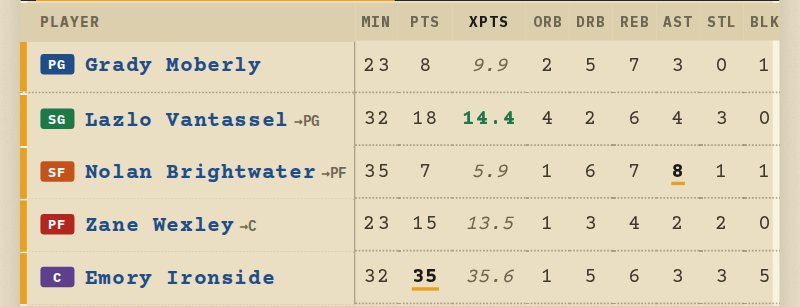
The box score shows all of it. Each starter is listed at his depth chart spot, and an arrow shows the spot he finished the game at when the sim moved him.

This season, by the numbers
I went through every starting lineup of this season's 560 regular-season games so far, 5,600 starting slots, and compared each player's spot at tip-off with his listed position.
About one starting slot in three is played away from the listed position, and most of those moves are one step over. The point guard and center slots almost always hold a natural point guard and a natural center. The middle three are where GMs experiment.
The most common moves are exactly the ones you'd expect: a center at the four, a point guard at the two, a two at the three, a three at the four. Human GMs and the AI clubs land in almost the same place: 31% of human-set starting slots and 33% of AI slots are away from the listed spot.
New: position conversions
Here's the part that went live today. If you keep playing a man at one neighbouring spot, game after game, he can officially become that position.
- 1One step overPG and SG, SG and SF, SF and PF, PF and C. Nothing bigger converts.
- 235 straight gamesThis season's regular-season and playoff games where he played 10+ minutes, at the same neighbouring spot.
- 3What breaks itA game at his natural spot or at a different spot. DNPs and short cameos don't count either way.
- 4It's officialHis listed position changes and his grade is worked out again for the new spot. Your scout tells you, and the Wire reports it.
- 5New season, new countEvery streak starts at zero when a season begins.
Only one-step moves convert: PG and SG, SG and SF, SF and PF, PF and C. A point guard will never be turned into a center. The count comes from real box scores: the spot he finished each game at. Only this season's regular-season and playoff games count, and only games where he played 10 minutes or more. A DNP or a short cameo doesn't count either way. A game back at his natural spot ends the streak, and so does a game at some other spot.
When it happens, his listed position changes for good, and his grade is worked out again for the new spot. Your scout tells you in your inbox, with his read at the new spot as a letter grade. The League Office posts it on the Wire for everyone.
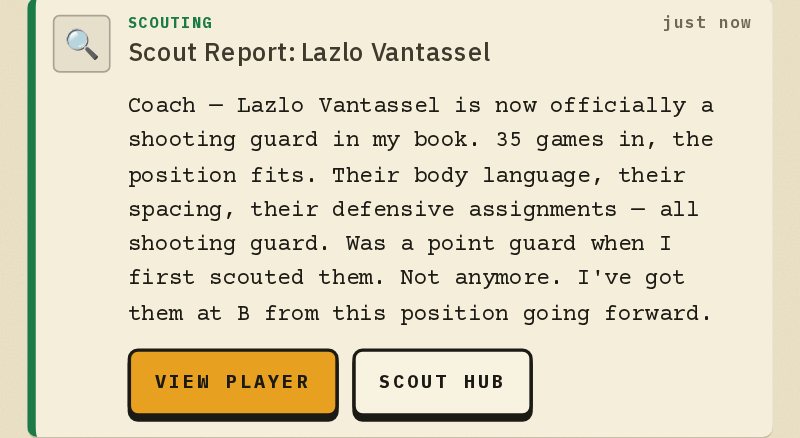

Every new season starts every streak at zero, so a conversion is always a full season's story, never a carry-over.
Where does the league stand? Right now 120 players are on a run at one neighbouring spot. Most are short: 109 of them are at four games or fewer. Eight are between five and nine, and three are past ten. The longest is 13. Nobody is close to 35 yet, so the first conversions are still a long way off. I'll be watching.
Ball handlers
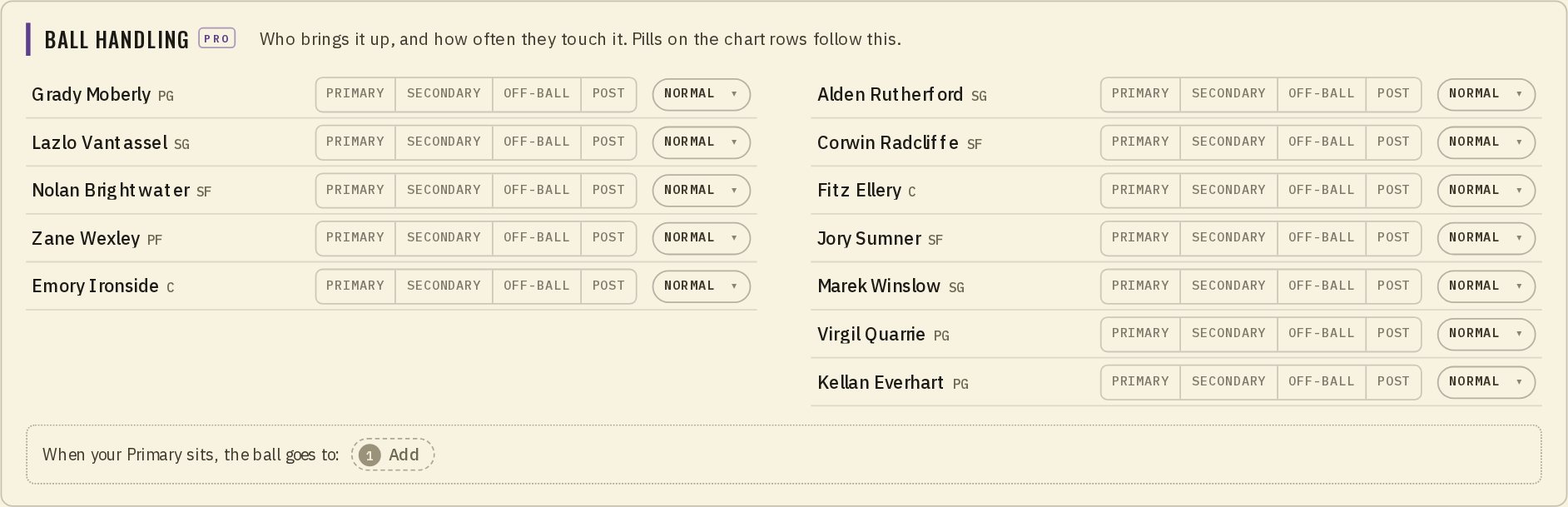
One last thing. Who brings the ball up follows the spot by default: the point guard starts the most trips, and the center the fewest, with handles and passing deciding the rest. If you'd rather choose for yourself, Ball handling in your Game Plan lets you name a primary, secondary, off-ball and post player and set how often each one touches it. Your roles then decide, wherever each man is lined up.
“The slot tells him where to stand. His size and his skills decide how well he plays there.”
Check your Depth Chart tonight and look at the little natural tags above your starters. Then tell me which of your players you think should be playing somewhere else.
— Dr. Possession